
Intel X710-DA4
MPN: Quick Code:
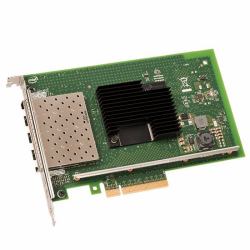
Note: Image accuracy is not guaranteed. Please do not rely solely on the image for your purchase.
€440.25 €532.70 inc. VAT
16 in stock Check stock Available
All products on this website are available duty-free in the EU
Overseas Customers with EU-VAT number do not pay VAT. -
- Quick Code:
- MPN:
- Manufacturer:
- Intel
- EAN Code:
Notify me when price drops
NOTE: The information below is provided for your convenience only and we cannot guarantee its accuracy. If necessary, please verify with us before purchasing.
iWARP delivers converged, low-latency fabric services to data centers through Remote Direct Memory Access (RDMA) over Ethernet. The key iWARP components that deliver low-latency are Kernel Bypass, Direct Data Placement, and Transport Acceleration.
Intel® Data Direct I/O Technology
Intel® Data Direct I/O Technology is a platform technology that improves I/O data processing efficiency for data delivery and data consumption from I/O devices. With Intel DDIO, Intel® Server Adapters and controllers talk directly to the processor cache without a detour via system memory, reducing latency, increasing system I/O bandwidth, and reducing power consumption.
PCI-SIG* SR-IOV Capable
Single-Root I/O Virtualization (SR-IOV) involves natively (directly) sharing a single I/O resource between multiple virtual machines. SR-IOV provides a mechanism by which a Single Root Function (for example a single Ethernet Port) can appear to be multiple separate physical devices.
Intel® Ethernet Power Management
Intel® Ethernet Power Management Technology provides solutions to common power management approaches by reducing idle power, reducing capacity and power as a function of demand, operating at maximum energy efficiency whenever possible, and enabling functionality only when needed.
Flexible Port Partitioning
Flexible Port Partitioning (FPP) technology utilizes industry standard PCI SIG SR-IOV to efficiently divide your physical Ethernet device into multiple virtual devices, providing Quality of Service by ensuring each process is assigned to a Virtual Function and is provided a fair share of the bandwidth.
Virtual Machine Device Queues (VMDq)
Virtual Machine Device Queues (VMDq) is a technology designed to offload some of the switching done in the VMM (Virtual Machine Monitor) to networking hardware specifically designed for this function. VMDq drastically reduces overhead associated with I/O switching in the VMM which greatly improves throughput and overall system performance